
Manufacturing floors had a system for this long before we did.
Back when I was assigned to the hose assembly plant in Easley, SC — yes, the same plant where that big orange robot arm scared the beejesus out of everyone — they were also in a full-court press to Lean manufacturing, complete with kaizen events, kanban board instructions, and yes, signage–everywhere. Five words. Sort, Set in Order, Shine, Standardize, and Sustain. It wasn’t theory or a philosophical debate about how they might improve. It was how the plant intended to survive. If a station wasn’t sorted, a person could grab the wrong part. If it wasn’t standardized, the next shift inherited your chaos. If nobody sustained it, the whole thing quietly rotted back to normal within a month.
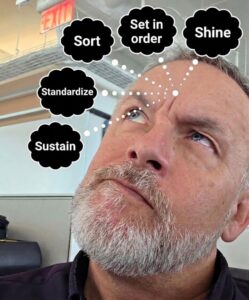 I hadn’t thought about those signs in years. Then I started watching large organizations try to bolt AI onto their Agile practices, and it hit me — we’re back on the shop floor. Different tools, same fundamental problem: a powerful new capability, moving fast, sitting right next to a lot of variation, ambiguity, and stuff nobody’s touched in years.
5S wasn’t built for software. It was built for manufacturing floors where a missing tool or a mislabeled bin could cost you a shift, or worse. But an agentic SDLC has the exact same failure mode. AI doesn’t care that your backlog is messy. It will happily generate epics from it, write code against it, and produce volume — lots and lots of volume — built on whatever was actually sitting on the shelf. Good or bad.
Here, it might be good to walk through the five S’s the way they were meant to be understood — plainly, generally — and then get into what they actually require of a large organization stitched together from a dozen different flavors of Agile, at a dozen different levels of maturity, trying to move into an AI-assisted (or AI-driven) way of building software.
The Five S’s, Briefly
Sort (Seiri) — Separate what you need from what you don’t. Get rid of the excess. Anything that isn’t earning its space on the floor is in the way of the thing that is. Wasted motion slows everything down.
Set in Order (Seiton) — Give everything that remains a home, and make that home obvious. A place for everything, and everything findable in seconds, not minutes.
Shine (Seiso) — Clean as inspection. You’re not wiping things down to make them pretty; you’re wiping things down so you notice the crack, the leak, the drift before it becomes a failure.
Standardize (Seiketsu) — Turn the first three into habits everyone shares, not tribal knowledge that lives in one person’s head or one team’s corner of the building.
Sustain (Shitsuke) — The discipline to keep doing it after the novelty wears off. This is the one that actually separates the plants that stayed clean from the ones where the laminated signs became wallpaper.

One final clarification–5S is not an à la carte menu either. It is a repeating cycle starting with Sort. For example, “setting in order” without having first sorted will mean that you are wasting time organizing crap you don’t need. Shining before you sort and set in order means you are polishing a turd. Standardizing without having sorted, set in order and shined means you will end up with a lot of polished confusion, and no one will know what the right path is. Sustaining all of that confusion is just a really bad idea. . . . and one I think many of us have experienced.
Sort: Figure Out What’s Actually on the Floor
Here’s the uncomfortable part. Most large organizations I’ve worked with don’t have one Agile practice. They have twelve, wearing the same name tag. One team runs textbook Scrum. Another runs something they call Scrum but is really just two-week deadlines with a standup bolted on. A third gave up on story points two reorgs ago and never told anyone. Layer AI on top of that and you’re not introducing one variable — you’re introducing one variable times twelve interpretations of “how we work.”
Sort, in this context, means an honest inventory before anything gets automated. Which ceremonies are load-bearing and which are cargo cult? Which templates for epics and requirements are actually good inputs for a human or an agent to work from, and which ones only ever made sense because a person was there to fill in the gaps verbally? AI is a brutally literal collaborator. It will take your half-finished acceptance criteria at face value and build exactly what’s written, not what you meant. Sorting means clearing out the ambiguous, the redundant, the “we’ve always done it this way” — before you hand any of it to something that executes at speed.
This is also where organizational structure makes first contact. Sorting at the team level isn’t enough if there’s no one looking across the twelve interpretations and asking which patterns should actually survive contact with AI tooling. That’s a role — a guild, a community of practice, a small cross-team council, whatever you want to call it — not a document nobody reads.
Set in Order: A Place for Every Prompt, Every Pattern, Every Piece of Context
Once you know what’s worth keeping, it needs a home an agent can find as easily as a human can. This is where a lot of organizations will likely struggle more and more without noticing the root cause. AI tooling is only as good as the context it can retrieve, and context that’s scattered across six wikis, four Confluence spaces, and one team’s private folder is context that doesn’t exist as far as the model is concerned. Likewise, 9 versions of the same concept and 4 more, written by AI, are too much context.
Set in Order, for an agentic SDLC, means real structural investment: a common location and format for product vision, a shared shape for epics and requirements that every team’s AI tooling can actually parse, and consistent naming and tagging so an agent working across team boundaries doesn’t have to guess. It’s the difference between “everyone knows where the acceptance criteria for the features live” and “The acceptance criteria live in a slide deck shared with a leadership team during a vision session two months ago.”
Shine: Inspection Gets More Important, Not Less
This is the S that changes the most under AI, and it’s the one I’d push back hardest on anyone who wants to skip. When a human writes a flawed requirement, you get one flawed feature. When AI writes code, generates epics, or drafts requirements from that same flawed input, you get volume — fast, confident, plausible-looking volume, wrong in ways that are easy to miss because it reads so cleanly.
 Shine used to mean “clean as you go.” In an agentic SDLC, it means validation as a first-class discipline, not a phase you get to if there’s time. Every AI-touched artifact — a feature, an epic, a generated PR — needs the review loop tightened, not loosened, because the failure mode isn’t a typo anymore. It’s confidently wrong architecture, quietly wrong acceptance criteria, a hallucinated edge case treated as gospel. Definition of Done has to lock down harder here: test automation, integration checks, security validation, someone actually reading the epic the AI drafted before it becomes ten stories nobody questioned. The bottleneck moves from “can we build it fast enough” to “can we validate it fast enough” — and an organization that hasn’t invested in that shift is going to find out the hard way.
Standardize: Make the Good Habits Boring
Sort, Set in Order, and Shine only matter across a large org if they stop being one team’s good idea and become everyone’s default. Standardize is where a lot of AI adoption efforts are likely going to die quietly, because it’s the least exciting S and the most necessary one. As an Agilist who constantly pushed for teams to “do what works best for them to deliver working software,” I wince at this one, but times have changed with AI SDLC. It’s not glamorous to say “every team uses the same epic template, the same structure for acceptance criteria, the same review gate before AI-generated code merges.” However, it’s the only thing that keeps twelve interpretations of Agile from becoming twelve incompatible ways of feeding an AI system.
Now, to be clear, Standardizing doesn’t mean flattening every team into identical process. It means the interfaces between teams — the shape of a requirement, the format of a handoff, the expectations for what “reviewed” means — are consistent enough that tooling, and the people supervising that tooling, aren’t relearning the rules every time work crosses a team boundary. This is also, not coincidentally, exactly where clear product vision and structured release planning stop being nice-to-haves. You cannot standardize what “good” looks like if nobody’s articulated what you’re actually building toward. Standardize is downstream of vision. Skip the vision and you’re just standardizing noise.
Sustain: The One That Actually Determines If Any of This Sticks
Every one of the 8 plants that I hopped around to had the laminated 5S signs. Sadly, not all of them had a floor that still matched the signs eight months later. Sustain is discipline, and discipline is unglamorous, and unglamorous things are the first casualties of a “move fast” culture — which is exactly the culture AI tempts every organization into. Those plants that faltered were the ones that skipped steps and ultimately could not sustain what they created. New garbage needed to be sorted, and it fell apart from there.
Sustaining 5S in an agentic SDLC means retrospectives that actually ask the new questions: which prompts and patterns worked, where did we over-trust the output, what needs to be corrected before it compounds. It means the Scrum Master or coach role widens rather than disappears — becoming a steward of how the team and its tools work together, not just how the humans do. And it means leadership treating this as ongoing tending, not a one-time rollout. The organizations that get this right aren’t the ones with the best initial policy. They’re the ones who kept walking the floor.
I keep coming back to those laminated signs. Nobody in that plant thought 5S was philosophically interesting. It was just what kept the line running and kept people from getting hurt. I think that’s the right way to hold this, too. An agentic SDLC doesn’t need a new framework bolted on top of Agile any more than that plant needed a new philosophy bolted on top of the line. It needs the fundamentals — sorted, ordered, inspected, standardized, sustained — because AI doesn’t create discipline. It just runs at the speed of whatever discipline was already there.
AI doesn’t improve organizational discipline; it amplifies whatever discipline already exists–both the good and the bad. Leaning on 5S gives us the framework for just such discipline.
